Inference stays on the body
Perception, planning and speech all execute on the spine accelerator. A dropped uplink degrades telemetry and remote hand-off — it does not stop the unit mid-task or leave it holding a load.
Gen 3 production slots — Q3 allocation open
Optimus Gen 3 is a general-purpose bipedal platform built for work that was shaped around people — the same doorways, the same totes, the same stairs. No rails, no cages, no floor markers.

Select a marker on the drawing — or a module below it — to open the detail card. Gen 3 was drawn around maintenance access first and styling second.
Not a demo reel. These are the behaviours the platform ships with on day one, and the interfaces you extend from.
Perception, planning and speech all execute on the spine accelerator. A dropped uplink degrades telemetry and remote hand-off — it does not stop the unit mid-task or leave it holding a load.
Every joint carries strain sensing, so contact is detected in under 8 ms and the limb yields instead of driving through. Speed and separation monitoring is aligned with ISO 10218 and ISO/TS 15066 practice.
Bimanual coordination for lids, straps, trays and anything that needs a second hand to hold position.
One pack covers a standard shift. A second pack and a 40-second swap covers the next one.
Python and ROS 2 bindings, a deterministic simulator, and signed over-the-air policy updates.
Model-predictive control resolves the full gait cycle in 1.42 seconds and recovers from a lateral shove in under 320 milliseconds. Stairs, thresholds, loading ramps and cable runs are handled by the same controller — there is nothing to paint on the floor and nothing to bolt to the ceiling.
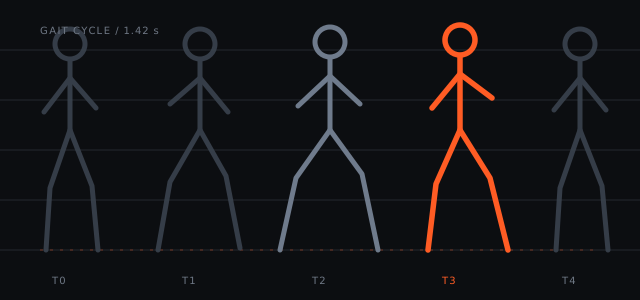
Figures are measured on a production Rev 3.4 unit at 20 °C with a standard manipulator pack fitted.
| Standing height | 1 732 mm |
|---|---|
| Mass, dry | 64.8 kgExcludes battery pack and end-effector options |
| Degrees of freedom | 28 actuated7 per arm · 6 per leg · 2 neck |
| Rated payload | 22 kg carried · 11 kg per hand |
| Reach envelope | 780 mm from shoulder centre |
| Walk speed | 1.7 m/s sustained |
| Step height | 210 mm |
| Repeatability | ± 0.4 mm |
| Ingress rating | IP54 |
| Pack capacity | 2.6 kWh LFP |
|---|---|
| Runtime, mixed duty | 9 h nominalApproximately 6 h under continuous full payload |
| Hot-swap | Supported, under 40 s |
| Charge to 80% | 55 min |
| Cycle life | > 3 000 cycles to 80% capacity |
| Dock input | 230 V · single phase |
| Standby draw | 18 W |
| Accelerator | 184 TOPS INT8, passively cooled |
|---|---|
| System memory | 32 GB LPDDR5 |
| Storage | 1 TB NVMe, encrypted at rest |
| Control loop | 1 kHz joint · 100 Hz whole-body |
| Perception latency | < 42 ms sensor to action |
| Interfaces | Python 3.11 · ROS 2 Jazzy · gRPC |
| Updates | Signed OTA with staged rollback |
| Cameras | 6 × 5 MP global shutter |
|---|---|
| Depth | Solid-state, 0.2 – 12 m |
| Combined field of view | 220° |
| Tactile points | 1 024 across both hands |
| Joint torque sensing | All 28 axes |
| Inertial | Dual redundant 9-axis IMU |
| Audio | 4-mic beamforming array |
| Contact detection | < 8 ms to yield |
|---|---|
| Emergency stop | Dual-channel, category 3 |
| Standards alignment | ISO 10218 · ISO/TS 15066Site certification remains the operator's responsibility |
| Audit log | Signed, 90-day rolling on-device |
| Remote stop | Operator console and physical fob |
| Fail state | Controlled crouch, brakes engaged |
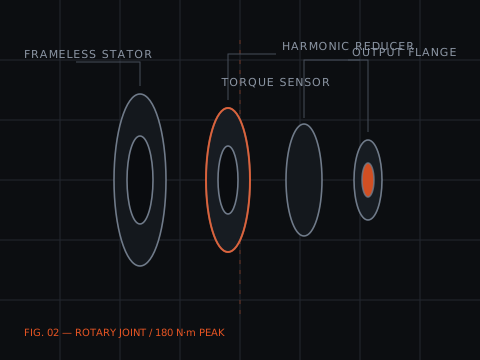
Frameless stator, harmonic reducer, torque sensor and output flange stack into one sealed cartridge. A joint is replaced, not rebuilt.
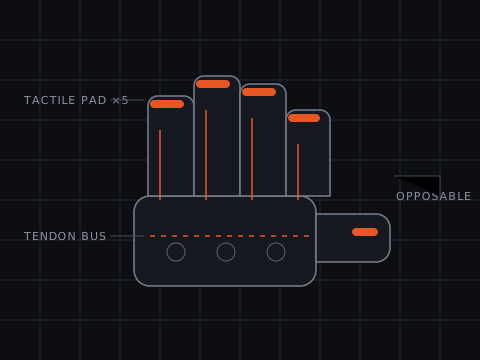
Five tendon-driven digits with capacitive pads on every fingertip. Grip force resolves per digit, from four newtons to one hundred sixty.
Each profile ships as a starting policy bundle. You adapt it to your site rather than writing behaviour from zero.
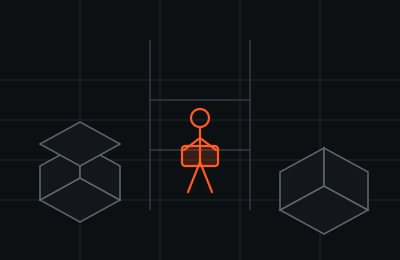
Tote induction, decant, put-wall replenishment and end-of-line palletising in an aisle sized for people.
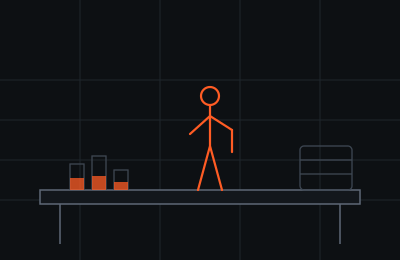
Rack loading, plate transfer and instrument tending on benches that were never designed for automation.
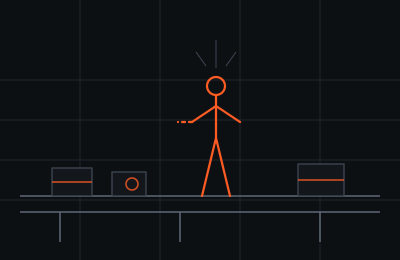
Machine tending, fixture loading, visual inspection rounds and after-hours facility checks.
Reservation holders receive a written schedule update each quarter, whether or not the date has moved.
Forty units built and run through 11 000 cumulative hours of structured duty cycling across three partner sites.
Joint stack consolidated into a single sealed cartridge, cutting mean field replacement time from 90 minutes to 14.
Current revision. Pilot allocation is being filled from the reservation queue in the order deposits were received.
Reservations placed now are assigned to this window. Configuration can be revised at no cost until the build lock date.
Regional spares depots and certified technician training, so a joint cartridge is on site inside one business day.
A reservation holds your place in the build queue. It is fully refundable until the build lock date — see the Refund Policy.
Step 05 — Reservation request
We reply by email within two business days with a written quotation and an allocation window. No call is scheduled unless you ask for one.
Your configuration has been staged. A written quotation and allocation window will reach the email address you provided within two business days.
No. A reservation records your configuration and holds a position in the build queue. A binding order only exists once a written quotation has been signed by both sides. Nothing is charged at the point you submit the form on this page.
Yes, at no cost, until the build lock date for your allocation window. That date is stated in your quotation. After the lock, changes are handled as a new configuration and may move you to a later window.
A single-phase outlet for the charger, floor space of roughly one square metre for the dock, and network access if you want remote telemetry. There is no ceiling infrastructure, no floor marking and no tracking hardware to install.
A written site readiness checklist is issued with every quotation.
The platform is engineered to align with ISO 10218 and ISO/TS 15066 practice, and ships with the documentation an assessor needs. Certifying the installed application at your site remains your responsibility as the operator, because it depends on your layout, your tasks and your local regulations.
Joints, packs and end effectors are sealed cartridges, replaced rather than rebuilt. Mean field replacement time for a joint cartridge is 14 minutes. Fleet plan holders get next-business-day dispatch from a regional depot.
Inference runs entirely on the unit. Telemetry and diagnostics are uploaded only if you enable them, and you choose the retention period. Details are set out in the Privacy Policy.
Gen 3 is sold to organisations for commercial, industrial and research use. It is not a consumer product and is not offered for domestic or personal use.
Q3 allocation is open now. Configure a unit, submit a request, and you will have a written quotation within two business days.